Impact of the Middle East Conflict on Inbound Travel to Germany
Regular GNTB Market Updates on the Iran Conflict
Status: August 26, 2026 (replaces the versions of July 21, 2026, July 8, 2026, June 11, 2026, June 1, 2026, May 13, 2026, May 8, 2026, May 4, 2026, April 22, 2026 and April 21, 2026).
The German National Tourist Board (GNTB) is responding to the escalation of the military conflict in the Middle East and its potential impact on inbound tourism to Germany with comprehensive measures. A dedicated crisis task force has been established to coordinate the continuous analysis of data on current developments. The weekly monitoring reports form the basis for intensive exchange with stakeholders, partners in the German and international travel industry, political actors, and cross-border tourism organizations.
With the signing of the Memorandum of Understanding between the USA and Iran on 15 June 2026, transit routes through the Strait of Hormuz are partial-ly reopening and there is a prospect of a peace deal. The crude oil price has fallen signifi-cantly. The price for a barrel of North Sea Brent fell on 8 July 2026 to around USD 77.72, while the US WTI grade fell to around USD 73.67.
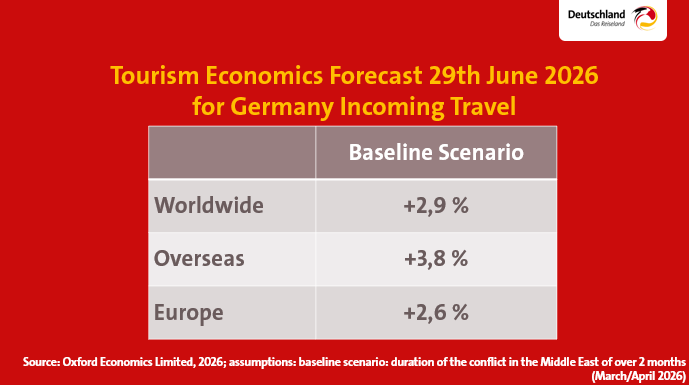
Oxford Economics raised its forecast for overnight stays by foreign guests in Germany in 2026 from +2.6% to +2.9% (2026 compared with 2025 in each case). Expected growth in overnight stays by European guests in Germany in 2026 is +2.6%, while overnight stays by overseas guests in Germany are expected to grow by +3.8%.
The implementation of the ceasefire has repeatedly been subject to serious violations, once again creating a high level of risk in the Gulf region. [Updated in the version of August 26, 2026]: In mid-August 2026, the USA threatened Iran with economic sanctions. Crude oil prices have risen and, as of August 26, 2026, stand at USD 86.91 per barrel for North Sea Brent crude and USD 80.84 per barrel for U.S. WTI crude.
[Updated in the version of September 21, 2026]: The U.S. Department of State warns of an escalation of the conflict between U.S.-allied Saudi Arabia and the Iran-backed Houthi militia in Yemen. In its travel advisory of September 15, 2026, U.S. citizens were urged to seriously reconsider travel to the region (“reconsider travel”).
[Updated in the version of September 21, 2026]: UN Assistant Secretary-General Khaled Khiari told the Security Council that the situation in and around the Bab al-Mandab Strait is becoming increasingly unstable. He also referred to reports of casualties and damage to residential buildings in several Saudi Arabian cities following Houthi missile and drone attacks on September 14, 2026.
[Updated in the version of September 21, 2026]: The European Union has strongly condemned the recent Houthi attacks on Saudi Arabia on several occasions. It views them as a dangerous escalation posing risks to regional stability, the security of international shipping in the Red Sea, and ongoing peace efforts in Yemen. The EU is calling on the Houthi militia to cease all attacks and continues to support diplomatic efforts to de-escalate the conflict.
[Updated in the version of September 21, 2026]: According to the U.S. Energy Information Administration, restricted oil exports from the Middle East and attacks on Saudi oil export routes through the Bab al-Mandab Strait contributed to the rise in crude oil prices. Crude oil prices continue to increase and, as of September 21, 2026, stand at USD 102.44 per barrel for North Sea Brent crude and USD 94.19 per barrel for U.S. WTI crude.
[Updated in the version of September 21, 2026]: The European Union Aviation Safety Agency (EASA) continues to highlight significant risks to civil aviation in the airspace of Bahrain, Kuwait, Qatar, the United Arab Emirates, and parts of Oman due to regional tensions and the persistently unstable security situation. EASA has updated Safety Bulletin CZIB-2026-07 as Revision 2 (CZIB-2026-07R2) and extended its validity until September 30, 2026.
[Updated in the version of September 21, 2026]: According to data from the German Federal Statistical Office, overnight stays by foreign guests in Germany reached 10.7 million in July 2026, representing an increase of 3.1% compared to July 2025. For the cumulative period January–July 2026, overnight stays by foreign guests totaled 47.1 million, 1.0% above the corresponding period of the previous year. Despite challenging market conditions, German inbound tourism recorded growth particularly in July 2026, driven in part by increases in international overnight stays from the Netherlands (double-digit growth of +11.6%), Switzerland (+2.9%), Poland and France (+3.6% each), as well as other European source markets, and from India (+3.6%) and Brazil (+16.0%).
[Updated in the version of September 21, 2026]: A further indicator of an optimistic outlook is provided by the latest GNTB Travel Industry Expert Panel for the third quarter. According to the survey, 45% of decision-makers in the international travel industry assess their current business in Germany positively—an increase of 17% compared to the previous quarter. Looking ahead, 51% have a positive outlook for business development over the next six months.
[Updated in the version of September 21, 2026]: In a survey of tour operators, wholesalers, OTAs, and DMCs conducted by the European Tourism Association (ETOA) on September 7, 2026, representatives of tour operators and destination management companies (88%) as well as suppliers/destinations (89%) reported at least moderate impacts of the Middle East crisis on their business. Tour operators and destination management companies reported declining demand and increased cancellations, while suppliers reported later bookings and fewer long-haul travelers. Additional pressures include risks related to prices and accessibility. Tour operators, wholesalers, OTAs, and DMCs are taking a more cautious view of 2027.
In a GNTB-exclusive survey conducted in 15 countries, 55% of international travellers worldwide indicated that they would book closer to departure due to the Middle East conflict.
As part of its Economic Impact Research, WTTC forecasts global growth of the tourism sector of 3.2% in 2026. For Europe, European GDP growth in 2026 is expected to reach only 1% due to continued inflationary pressures and economic uncertainty, while travel and tourism GDP is expected to grow by 3.6%. According to the report, international visitor spending across Europe is expected to increase by 7.1%. Travel and tourism are expected to support 376 million jobs worldwide by 2026, equivalent to one in nine jobs globally.
[Updated in the version of September 21, 2026]: In its publication of September 17, 2026, UN Tourism expects international tourist arrivals worldwide to grow by 1% to 2% in 2026, in light of the latest data and ongoing geopolitical uncertainties. This is below UN Tourism’s January forecast, which had projected growth of 3% to 4%. However, actual developments will depend on how long the conflict lasts and what impact it has on oil prices and overall inflation.
[Updated in the version of September 21, 2026]: According to UN Tourism, international tourism remained resilient, recording growth of 0.4% in the first half of 2026, while the Middle East conflict and rising costs slowed momentum.
Market Assessment
Short-term Impact on Travel Flows Following the Military Escalation
According to analyses by Tourism Economics, 14 percent of global international transit traffic passes through hubs in the Gulf; around 28 million trips from the Middle East are affected, 60 percent of them to Europe.
In Germany, 4.2 percent of all flight arrivals in 2025 were via hubs in the Gulf states – of which 55.1% were direct arrivals from the UAE and 44.9 percent were transit passengers.
Looking at individual source markets, in 2025 73.2 percent of guests from the Gulf states travelled to Germany via Dubai / Abu Dhabi / Doha, as did 31.4 percent of guests from Singapore, 16 percent of Indian tourists, 6.9 percent of Chinese tourists and 4.6 percent of Japanese tourists.
Following a decline of 39% in flight arrivals to Germany via Gulf hubs in March 2026 compared to March 2025, a gradual improvement was recorded, with the decline narrowing to -31% in April 2026 compared to April 2025 and -18% in May 2026 compared to May 2025. In June 2026, flight arrivals to Germany via Gulf hubs weakened again, declining by 29% compared to June 2025. [Updated in the version of August 26, 2026]: In July 2026, flight arrivals to Germany via Gulf hubs improved, with the decline narrowing to -22% compared to July 2025.
Seat capacity from the GCC region (UAE, Saudi Arabia, Oman, Qatar, Kuwait, Bahrain) recovered from -32% in June 2026 to -15% in July 2026. [Updated in the version of September 21, 2026]: In August 2026, seat capacity also remained 15% below the level recorded in August 2025.
As markets directly affected by the Middle East conflict, Israel generated 0.6 million overnight stays in Germany in 2025, representing a market share of 0.8%, while the Gulf states generated 1.2 million overnight stays, representing a market share of 1.5%. However, due to the above-average travel spending of travelers from the GCC, these declines have a disproportionately strong impact on economic value creation.
Economic Impact.
The EU Commissioner for Sustainable Transport and Tourism, Apostolos Tzitzikostas, stated on 24 June 2026 that the Iran war, which broke out in ear-ly March, had had a significant impact on global travel activity and had once again shown how important resilience is.
OECD Europe ranks first among import regions dependent on the Middle East. The Middle East has typically supplied up to 375 thousand barrels per day, or 75% of Europe’s net jet fuel imports. In April 2026, North America and Africa (Nigeria) are replacing parts of jet fuel imports from the Middle East.
According to Amadeus data, no increase in average base fares (excluding taxes and surcharges) for flights to Germany from the USA, China, and Japan was recorded in July 2026. For flights from India to Germany, average base fares increased by 1.8% during the same period.
With the exception of flights from the UAE to Germany, where average base fares increased by 12.6%, average base fares from the region declined in July 2026 compared to July 2025.
At the same time, gasoline prices have risen significantly, meaning the industry expects an impact on travel costs for car travel in Europe. With a share of 44% in the modal split, the car is the main mode of transport for European travelers to Germany.
Airlines, including Lufthansa, are reducing capacity. According to The Guardian, around 2 million airline seats worldwide were removed from May flight schedules. This is due to sharply rising jet fuel prices and increased planning uncertainty. According to Cirium data, around 13,000 fewer flights are expected to operate in May. While this represents less than 2% of global capacity, the impact may be significantly more noticeable on individual routes and at specific hubs.
[Updated in the version of September 21, 2026]: The impact on maritime transport has now become apparent. The IEA reports severely restricted oil and petroleum product shipments from the Gulf region, significantly higher tanker costs, and declining global inventories. Additional attacks on Saudi Arabia’s East-West Pipeline and risks around the Bab al-Mandab Strait are also limiting important alternative routes. However, the scale and duration of the broader economic impacts remain uncertain.
A potential global economic crisis caused by disrupted logistics chains could also weaken tourist flows due to declining purchasing power in affected source markets. However, there are currently no reliable indicators of this. Experts differ in their assessments of how quickly the reopening of the Strait of Hormuz could lead to a recovery in the global economy.
Resilience of German Inbound Tourism
Around 77% of foreign overnight stays in Germany are generated by intra-European travelers. In addition, intra-European travel is expected to increase in 2026 as a result of the current conflict. A survey conducted by the European Travel Commission following the outbreak of the Iran war shows an 8% increase in intra-European travel intentions compared to the same period of the previous year. An update of this survey, conducted between mid- and late May 2026, shows that 64.5% of European travelers are opting to travel within Europe.
This is confirmed by an initial study conducted by Appinio on behalf of the GNTB following the outbreak of the Iran war, according to which travel intentions to Germany are increasing in the major source markets of the Netherlands and Belgium.
For search volume for Germany during the period from 28 February 2026 to 21 June 2026, Expedia recorded almost stable search demand compared with the same period of the previous year (-0.3%), putting Germany above the search volume for Europe (-2.4%). Bookings in Germany for this comparison period show sta-ble revenues (+2.9%) despite lower overnight stays (-0.4%).
[Updated in the version of September 21, 2026]: Official statistics for the period January–July 2027 confirm this: overnight stays by international guests in Germany increased by 1.1%, while overnight stays by international guests from overseas declined by 2.8%.
Conclusion
The military conflicts in the Middle East are having both direct and indirect effects on inbound tourism to Germany.
Opportunities for Germany as a travel destination in international competition are based on its positive image as a safe, high-quality destination and the current trend toward intra-European travel.
Among European competitors, Germany benefits from a very competitive price level.
[Updated in the version of September 21, 2026]: Among European competitors, Germany benefits from a very competitive price level. According to MKG Consulting, hotel prices in Germany averaged €97.20 in July 2026, a peak travel month, significantly below those of competing destinations such as France (€134.80), Italy (€168.80), Spain (€170.40), and Austria (€107.50).
Overall, there are realistic chances that declines from the Middle East can be structurally offset by visitors from Europe and overseas markets such as the USA, China, Japan, or India. Previous crises have already demonstrated the high resilience of inbound tourism due to its broad market diversification.
Provided there is no further escalation of the conflicts and no global economic crisis emerges, German inbound tourism could once again prove to be resilient.
Up until the outbreak of the Iran conflict, the GNTB had projected growth in global inbound tourism to Germany of +3.2% for 2026, based on the assumption of a stable geopolitical environment without sharp increases in oil prices or inflation.
The Tourism Economics forecast of June 29, 2026, assumes the following scenario for German inbound tourism ([Updated in the version of August 26, 2026]: overnight stays by international guests in Germany):
Overseas
- High economic relevance despite a low volume share of 1.5 percent of Germany incoming tourism: guests from the GCC generate around EUR 3.0 billion in reve-nue and spend on average about twice as much as the global average.
- High structural dependency: 73.2% of flight arrivals from the UAE to Germany are routed through these hubs
- Significant market correction: GNTB forecast for 2026 revised from +5% to -14% [Updated in the version of September 21, 2026]: current overnight stays January–July 2026 compared to January–July 2025: -22.6%).
- Travellers are placing greater emphasis on flexibility and value for money, reflect-ed in shorter booking windows, refundable fares and alternative routes.
- At the same time, demand is increasing for new travel formats such as longer stays and combined leisure and remote-work concepts.
- Postponement of ATM to 14–17 September 2026: The planned participation will be adjusted accordingly to the new date in summer. The concrete format is cur-rently being coordinated closely with the trade fair and the German partners.
- Against the backdrop of current developments, the GNTB is continuously assessing the situation in the GCC markets and deciding on further market activities on a day-to-day basis. The aim is to maintain Germany’s market presence and deploy marketing budgets responsibly.
- Israel is experiencing severe disruptions in air traffic, leading to a decline of 75% in passenger arrivals and a 79% reduction in seat capacity. [Updated in the version of August 26, 2026]: In August 2026, seat capacity from Israel to Germany was 21% above the level recorded in August 2025.
- Against the backdrop of the severely restricted market situation, the GNTB is closely monitoring further developments and maintaining continuous exchange with local key accounts in order to identify market changes at an early stage and enable rapid reactivation once conditions stabilize.
- Asian markets show a differentiated but overall stable development. Demand remains intact but is more volatile than in Europe or North America and reacts more sensitively to external shocks.
- China and India show strong momentum at the beginning of the year, with continued growth expected for 2026.
- Schengen visa applications from China increased by 20% in the first quarter of 2026 compared to the first quarter of 2025.
- Different levels of dependence on Middle Eastern hubs: China (6.9%) and Japan (4.6%) are only minimally affected and benefit from stable, broadly diversified flight connections via direct routes and alternative European hubs. India, with a share of around 16%, shows significantly higher dependence, but can at least partially mitigate the impact through alternative direct connections.
- Alternative connections from India to Germany departing from Indira Gandhi International Airport, Chhatrapati Shivaji International Airport Mumbai, and Kempegowda International Airport Karnataka.
- Indirect impacts affect all markets: longer routes, reduced capacity, and higher prices are slowing booking dynamics and increasing demand for direct connections.
- The focus of the GNTB market activities is on close monitoring of market developments and ensuring continuous presence. At the same time, exchange with relevant key accounts is being intensified in order to identify market changes at an early stage and respond flexibly.
- A study by market research firm MMGY from February 2026 shows that international travel intent among U.S. travelers is at a multi-year high: 36% of active U.S. leisure travelers plan to travel abroad within the next six months—the highest level since before 2020.
- North American markets remain robust. Connectivity and demand remain stable, supported in part by the positive development of air connections between Europe and North America.
- Operational feedback shows no decline in demand or significant cancellations. Bookings and existing travel plans remain stable. However, customers are taking more time to make booking decisions.
- The USA and Canada recorded a positive trend in overnight stays in Germany in the first half of 2026: overnight stays from the USA increased by 0.5%, while overnight stays from Canada rose by 3.9%.
- Stability factor target group structure: Travelers to Germany from the upscale segment are less sensitive to economic uncertainties and demonstrate comparatively stable travel intentions.
- Due to stable demand, the GNTB is focusing on further leveraging potential in North America, particularly through targeted outreach to the upscale segment. At the same time, close cooperation with key accounts is being maintained in order to secure existing bookings, support conversion, and generate additional demand impulses.
Europe
- [Updated in the version of August 26, 2026]: In July 2026, flight prices from Spain to Germany increased: according to an analysis of data from Amadeus/ForwardKeys, average base fares (excluding taxes and surcharges) rose by 3.8% compared to July 2025. For flights from the UK to Germany, average base fares increased by 0.2% in July 2026 compared to July 2025.
- Implications for GNTB market activities: targeted communication of Germany’s strong value for money compared to competing destinations, along with an increased focus on promoting rail travel as an attractive alternative.
- The Netherlands and Belgium remain key source markets for stabilizing inbound tourism to Germany during the crisis: a GNTB study from March shows increased travel intentions to Germany in the Netherlands from 32% (September 2025) to 37% (March 2026), and in Belgium from 17% to 23%. [Updated in the version of September 21, 2026]: This is reflected in the overnight stay figures for the period January–July 2026 (Netherlands: +5.4%, Belgium: +2.2%).
- Rising transport and energy costs remain a burden: higher flight prices due to jet fuel costs as well as increasing cost pressure in car travel (44% share). However, Germany benefits from strong rail connections to key nearby markets.
- In response, the GNTB has been strengthening communication in nearby markets since the end of April through a high-reach Expedia campaign, “Next Stop Travel Destination Germany.” In Austria and Switzerland, the marketing of bus travel is also being specifically intensified.